<TRANSFORM/STUDIO>
Validate an invoice
Menu
PINT A-NZ · Peppol · XRechnung · EN 16931

Know whether the invoice matches the format that actually matters.

Transform Studio checks your invoice XML against the format your customer requires, explains each failure in plain language, and turns recurring export problems into a fixed-price fix or a production-ready transformation.

No account required One UBL invoice or credit note Exact ruleset recorded
Free invoice check
One XML file · result in seconds
Available now

Choose the format yourself, or anonymize first

PINT A-NZ Peppol BIS XRechnung EN 16931
You get: a pass or fail, each issue explained, and the exact rules used.
Not covered: Peppol delivery, acceptance by your customer, tax correctness and source-system mapping.
No universal Australian private-sector deadline applies to every business. The applicable profile and date come from the receiver, procurement contract, network or public-sector rule. New Zealand mandated agencies have specific eInvoicing and prompt-payment obligations from January 2026.
Current A-NZ rules PINT A-NZ 1.1.3 production-current · released 2026-05-21
What the evidence means

A pass/fail headline, with the reasoning underneath.

The free check tells you which format was tested and exactly which rules failed. A paid assessment turns those failures into reviewed root causes, a fixed scope and evidence your systems team can act on.

invoice-1047.xml Illustrative example Target profile failed
2 blocking findings
PINT A-NZ 1.1.3 · UBL invoice
IBR-120
Seller ABN format is invalid

Points to party-master data or formatting logic in the export, not a generic XML syntax issue.

IBR-SR-63
Specification identifier contains a wildcard

The current PINT rule requires the invoice identifier to be exact; receiving-capability wildcards belong elsewhere.

What one validation proves

Payload conformance

Structure and business rules for the exact selected profile.

Ruleset identity

Version, lifecycle, effective date and governed evidence are recorded.

Not network delivery

A valid payload can still fail transport, registration or receiver routing.

Not tax or legal advice

Amounts, commercial facts and statutory obligations need their own authority.

Review data handling
How the service works

Start free. Price follows the work.

Every paid engagement begins with evidence. You see the initial result, we review what the failures actually represent, and the quote is bound to a specific scope before production work starts.

  1. 01 · Validate

    Run the target profile

    Upload one invoice. Its format is detected, or you choose it, and the result arrives in seconds.

  2. 02 · Diagnose

    Separate symptoms from causes

    Rule occurrences are grouped into mechanical corrections, source-data gaps, mapping defects and further diagnosis.

  3. 03 · Approve

    Authorise a defined outcome

    You approve one fixed-price quote and its scope. Corrected files, reports and builds are then delivered against that baseline.

Service paths

Choose the outcome, not a generic “compliance package”.

A rejected e-invoice can delay payment. Choose whether you need today’s batch corrected, the recurring export problem fixed at the source, or a tested transformation built.

Emergency remediation

Correct the current batch

For a small number of mechanically safe failures where the source values are already authoritative.

  • Corrected, resubmittable files
  • Before/after correction record
  • Target-profile revalidation
Transform Build

Build the source-to-target transformation

For source exports that need a documented mapping, an implementation and a set of representative test invoices.

  • Versioned mapping specification
  • Validated transformation package
  • Regression and target-profile evidence
Release assurance

Re-test when the rules change

PINT and related rules change over time. An agreed set of your invoices is re-checked against each new release.

  • Ruleset-change impact review
  • Regression results
  • Scoped remediation where required
“Won’t the ERP produce another broken invoice tomorrow?” Corrected files alone are a painkiller, not a cure. The root-cause specification identifies the permanent change; Transform Build exists when the original export is not worth preserving.
Representative deliverable

Evidence a systems team can act on.

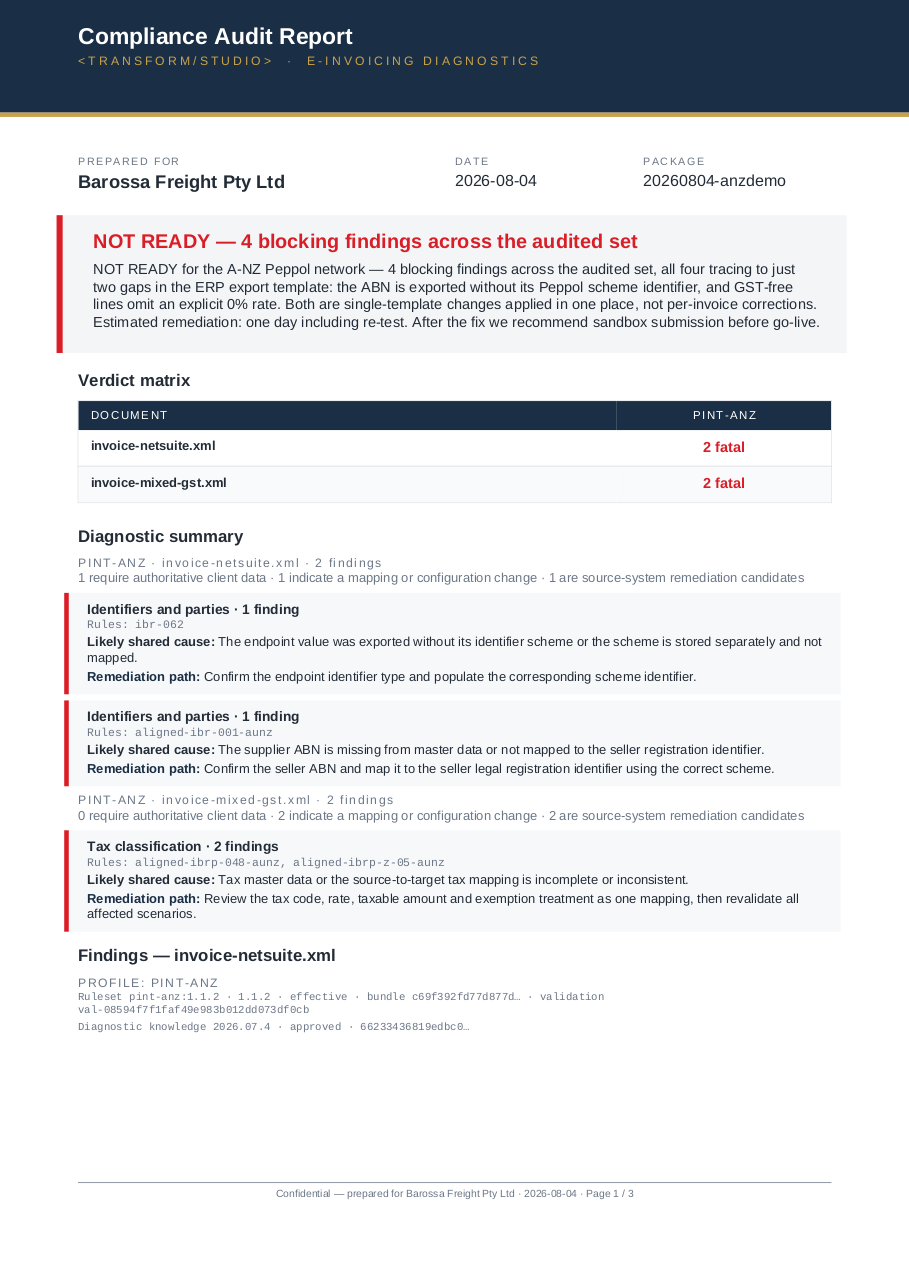
The final report records the original position, reviewed causes, correction decisions, final validation, limitations and the exact ruleset used.

When corrections are applied, the correction record identifies the rule, recipe and checks used to verify that monetary values were untouched.
First page of a sample Transform Studio compliance audit report Open the full sample report (PDF)
XML

Corrected invoice XML

Final client payload with target-profile pass evidence and immutable revision information.

PDF

Compliance audit report

Executive verdict, root causes, corrections, unresolved limitations and assurance boundary.

JSON

Machine-readable evidence

Checksums, validation identifiers and governed findings retained for audit and regression.

Current field note

The current A-NZ specialisation is PINT A-NZ 1.1.3.

PINT A-NZ is the current Australia and New Zealand billing specialisation. The official billing and self-billing releases are maintained by the Australian and New Zealand Peppol Authorities and marked Final. The ATO describes a biannual release cycle for the A-NZ invoice specification. Transform Studio pins the exact qualified bundle used for each result; an upcoming release is never presented as the production-current verdict.

Bundled release
PINT A-NZ 1.1.3
Lifecycle
production-current
Effective from
2026-09-07
Released
2026-05-21
Recorded in
every validation result and audit report
Request an assessment

Bring one failing invoice and the receiver requirement.

The fastest start is the free check. For a recurring failure, a deadline or a new integration, tell us the source system and the format your customer requires, and we’ll set up a secure client portal.

Fixed-price scope before paid production begins.
Files are uploaded through the client portal, not attached to email.
Payload conformance is kept separate from delivery, receiver and legal assurance.

Fields marked are required.

The secure portal link is sent to this address.

Example: PINT A-NZ invoices from NetSuite fail the receiver’s ABN and tax-subtotal rules. Go-live is 30 September.

Do not send invoice files by email. Upload them through the secure portal link.